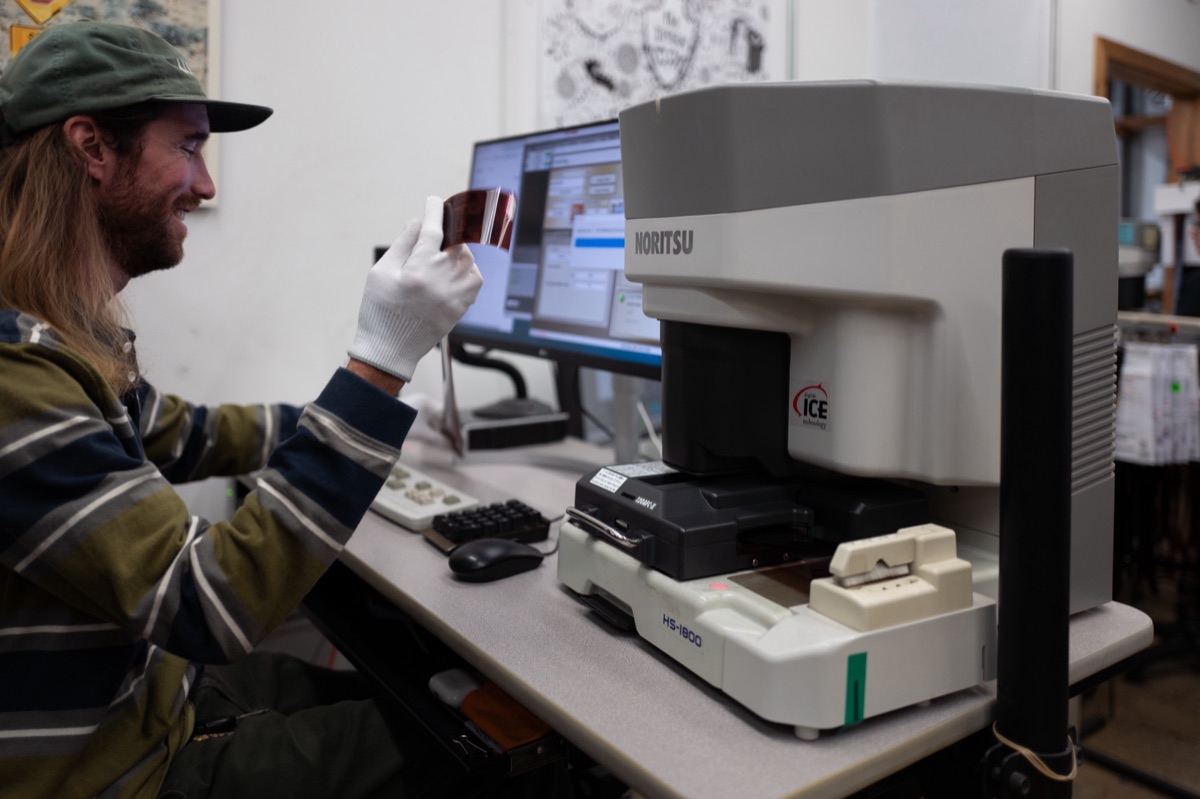
Yes, 120 film developing is still available, and we do it in our own lab. Color (C-41), black & white and E-6 transparency rolls of medium format film are developed and scanned in-house, uploaded to your free web gallery, and your negatives are mailed back. 620 and 220 rolls are welcome too.
Start Your 120 Order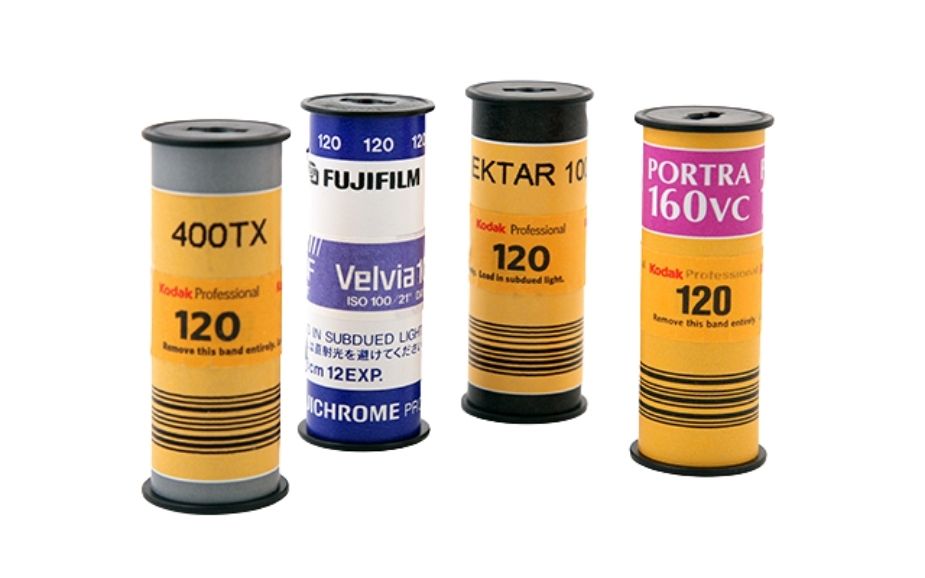 We processC-41 · B&W · E-6
Quality developingSince 1976
Found a paper-wrapped roll in a camera bag or inside an old box camera and not sure what it is? Here’s how to tell 120 film from its medium format cousins.

Medium format rolls run through our Refrema dip-and-dunk developers, where the film hangs on racks instead of passing through rollers. Here’s what we process, what you get back, and what to check before you mail it.

One price per roll of 120 film, with the add-ons you choose at checkout. No hidden fees.
| Add-ons per roll | |
|---|---|
| Enhanced scans Our recommended size | + $2 |
| Super scans Largest files, best for enlargements | + $6 |
| Color 4×6 prints | + $10 per set |
| Color 5×7 prints | + $18 per set |
| True black & white 4×6 prints On real silver gelatin paper | + $20 per set |
| Transparency film (E-6) The slide film option at checkout | + $6 |
| 220 film Twice the frames of a 120 roll | + $10 |
| Panoramic format 6×12 and 6×17 cameras | + $10 |
| Push or pull processing | + $3 |
| Cross processing E-6 film run through C-41 | + $3 |
| Do not cut negatives | + $3 |
| Other options | |
| Develop only, no scans Add $10 for a 220 roll | $11 |
| Inbound shipping Printable label or free postage-paid mailer | Free |
| Return shipping Unlimited rolls per order | $6.95 |
Pick 120 / 620 as your film type, choose your scan size and any prints, and check out. One order can hold as many rolls as you have, and you can mix in 35mm or any other format.
Print your free shipping label, or request a postage-paid mailer and we’ll send one to you. Tape the paper band on each exposed roll, drop the rolls in, and send it.
We email you the moment your scans land in your online gallery. Share, download, or order prints. Your negatives and any prints follow in the mail.
A search for 120 film developing near you usually ends at a photo counter that mails the film out anyway. Most drugstore and big-box counters either don’t accept 120 rolls at all or send them to a third-party lab, with turnaround measured in weeks and, in many cases, no negatives returned. We develop 120 film in our own lab in California, and your negatives always come back to you.
Yes. We develop 120 rolls that have been sitting in cameras and drawers for decades. Expect some color shift, fading, or heavier grain, especially if the film was stored somewhere warm. Black & white rolls from any era, including Verichrome Pan, are developed as black & white. The one exception is color film marked C-22 or Kodacolor-X (made before 1973), which uses a chemistry no longer available. We can process those as black & white instead.
It depends on the camera, not the film. A roll of 120 is about 32 inches long and gives 16 frames in a 6×4.5 camera, 12 at 6×6, 10 at 6×7, 8 at 6×9 and 6 at 6×12. A 220 roll holds twice as many.
All three use the same 61.5mm-wide film. 620 is 120 film wound on a thinner, narrower spool for Kodak’s own cameras, made from 1931 to 1995. 220 is twice as long, with backing paper only at the ends, so it needs a camera or film back built for it. We develop all three: 620 is priced as 120, and 220 adds $10 for the extra frames.
In everyday use, yes. Medium format means any film larger than 35mm and smaller than 4×5 sheet film, and 120 is the only medium format roll film still in regular production, so photographers use the two terms interchangeably. Our medium format guide goes deeper on the cameras and frame sizes.
Enhanced is our recommendation for most rolls: it is the size we suggest for sharing, printing at everyday sizes and keeping a good digital copy. A 120 negative holds far more detail than 35mm, so Super scans are worth it if you plan large prints or heavy crops. You can always order a bigger scan of a favorite frame later from your negatives.
Yes. We run E-6 in house, so Ektachrome E100, Velvia 50, Provia 100F and any other 120 E-6 film is welcome. In medium format it is called transparency film rather than slide film, since the frames are not mounted as slides. Choose the slide film option at checkout. Your transparencies are scanned and returned to you as unmounted strips. Prefer the cross-processed look? Choose cross processing instead and we run your E-6 film through C-41.
Once your film reaches the lab, most 120 orders are developed, scanned and uploaded to your gallery in 2–4 days. We are in Southern California, and mail reaches us in 2–5 days from almost anywhere in the US. For anything current that might affect that, see our lab status page.
Always. Your developed 120 negatives are cut into strips and returned with your order, along with any prints. If you want the roll back in one piece, choose “Do not cut negatives” at checkout.
The roll film that started in a Brownie in 1901 and became the medium format standard. Part of our guide to popular film formats.
Kodak introduced 120 film in 1901 for the Brownie No. 2, a cardboard box camera that sold for two dollars and put photography in the hands of ordinary families. Kodak numbered its roll films in the order they appeared, starting at 101 in 1895, and 120 was simply the twentieth size. Dozens of those numbered rolls came and went over the next half century. 120 outlived every one of them.
For the first fifty years it was the amateur’s format, loaded into box cameras and folding cameras by the million. When 35mm took over the snapshot market in the 1960s, 120 film went the other way and became the professional’s choice: the Hasselblad 500C, the Rolleiflex twin-lens reflex, the Mamiya RB67 and the Pentax 67 were all built around it, and it stayed the standard for wedding, portrait and fashion work until digital arrived. Today it is the only medium format roll film still in full production, which is why “120” and “medium format” have come to mean the same thing.

120 film has no cassette. The film is taped to a strip of opaque backing paper that runs the whole length of the roll, with extra paper at each end so the roll can be loaded and unloaded in daylight. You thread the paper leader onto the empty spool in the camera, close the back and wind until the start arrow lines up, and when the roll is finished you keep winding until the paper runs off the supply spool. There is no rewind. The exposed roll comes out wrapped in its paper, and a sticky band on the trailer seals it shut.
The backing paper is printed with frame numbers in three rows, one each for 6×4.5, 6×6 and 6×9 cameras. Older cameras show those numbers through a small red window on the back, which is how you know when to stop winding. Later cameras count the frames themselves. It is also why the paper matters when you mail the film: that band is the only thing keeping an exposed roll light-tight, so tape it down.
The strip of 120 film is 61.5mm wide, about 2.4 inches, with no sprocket holes along the edges. The exposed image is 56mm tall, and its width depends entirely on the camera. A 120 roll is roughly 82cm (32 inches) long, so the frame size also decides how many pictures you get per roll:
| Frame size | Negative (approx.) | Pictures per 120 roll | Typical cameras |
|---|---|---|---|
| 6×4.5 | 56 x 42mm | 16 | Mamiya 645, Pentax 645, Fuji GA645 |
| 6×6 | 56 x 56mm | 12 | Hasselblad 500 series, Rolleiflex, Holga, Diana |
| 6×7 | 56 x 69mm | 10 | Mamiya RB67 and RZ67, Pentax 67, Mamiya 7 |
| 6×9 | 56 x 84mm | 8 | Fuji GW690, folding cameras, Brownie box cameras |
| 6×12 / 6×17 | 56 x 112mm / 56 x 168mm | 6 / 4 | Panoramic cameras (scanned with the panoramic option) |
For comparison, a 35mm frame is 24 x 36mm. A 6×6 negative has about three and a half times that area, and a 6×9 negative more than five times. That extra film is why medium format scans look so smooth: the grain is the same size, but it is enlarged far less to reach the same print.

620 film is the same 120 film wound onto a slimmer metal spool with thinner flanges. Kodak introduced it in 1931 so its own cameras could be a little smaller, and made it until 1995. The film has not changed, so an old 620 camera shoots happily today with 120 film respooled onto a 620 spool in the dark. Our how-to on resurrecting old 620 cameras with 120 film walks through it, and we develop the result as 120.
220 film, introduced in 1965, is 120 at twice the length. Dropping the backing paper behind the picture area is what makes room for the extra film, so a 220 roll needs a camera or film back with a pressure plate set for it, and it cannot be used in a red-window camera. Most 220 stocks are discontinued, but rolls still turn up in freezers and we develop them, with a $10 add-on for the extra frames.
120 film never went away, and the last few years have been good to it. Kodak makes Portra, Ektar, Tri-X and T-Max in 120 and added Gold 200 to the lineup in 2022. Ilford keeps HP5 Plus, FP4 Plus, Delta and XP2 Super in production and brought its budget Kentmere films to 120 in 2023. Fujifilm still makes Velvia and Provia transparency film, CineStill offers its 400D and 800T in 120, and Lomography and Foma round out the shelf. On the camera side, a Holga or Diana costs less than a roll of Portra and a weekend of shooting, while clean Hasselblads, Mamiyas and Pentax 67s change hands for more than they did new. Either way, the roll that comes out of the camera is the same 120 film we have been developing since 1976.
Not sure whether to shoot 35mm or 120? Our guide to choosing between 35mm and 120 film compares the cost per frame, the look and the cameras.
Sources: Camerapedia, Kodak and Ilford product histories.
Every format has its own page, with the history and the developing details. Or see the whole guide.





 FAQ