828 film is Kodak’s Bantam roll film: ordinary 35mm-wide film with no sprocket holes, wound on a tiny spool with paper backing, giving eight 28 x 40mm pictures a little larger than a 35mm frame. Yes, it can still be developed, and we do it in our own lab, whether it is an original Kodak roll found in a Bantam or 35mm film you respooled yourself. Scans go to your free web gallery and your negatives are mailed back.
Start Your 828 Order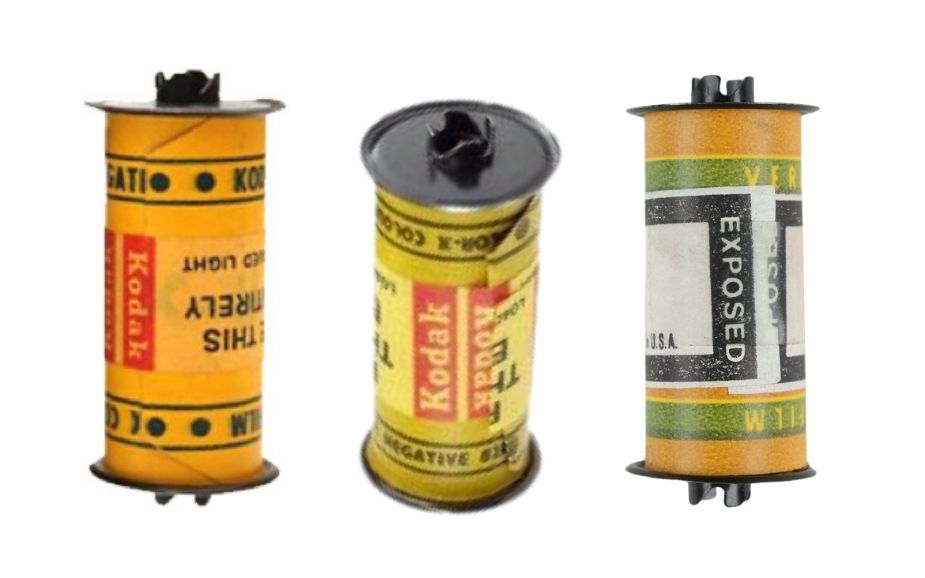 We processC-41 · B&W · E-6
Quality developingSince 1976
A tiny paper-wrapped roll, smaller than 127, that came out of a little folding Kodak? Here’s how to tell 828 film from the rolls and cassettes it gets mistaken for.
No 828 has been made since 1985, so every roll of 828 film is either a decades-old find or 35mm film respooled for a Bantam. Both are developed here, as roll film. Here’s what we process, what you get back, and what to check before you mail it.

One price per roll, the same as 120, with the add-ons you choose at checkout. No hidden fees.
| Add-ons per roll | |
|---|---|
| Enhanced scans Our recommended size | + $2 |
| Super scans Largest files, best for enlargements | + $6 |
| Color 4×6 prints | + $10 per set |
| True black & white 4×6 prints On real silver gelatin paper | + $20 per set |
| Slide film (E-6) | + $6 |
| Push or pull processing | + $3 |
| Do not cut negatives | + $3 |
| Other options | |
| Develop only, no scans | $11 |
| Inbound shipping Printable label or free postage-paid mailer | Free |
| Return shipping Unlimited rolls per order | $6.95 |
Pick 120 / 620 as your film type; 828 needs no add-on. Choose your scan size and any prints, note “828” in the order notes, and check out. One order can hold as many rolls as you have.
Print your free shipping label, or request a postage-paid mailer and we’ll send one to you. Tape the band on each roll, note anything unusual, and send it.
We email you the moment your scans land in your online gallery. Share, download, or order prints. Your negatives, your spool and paper if you asked for them, and any prints follow in the mail.
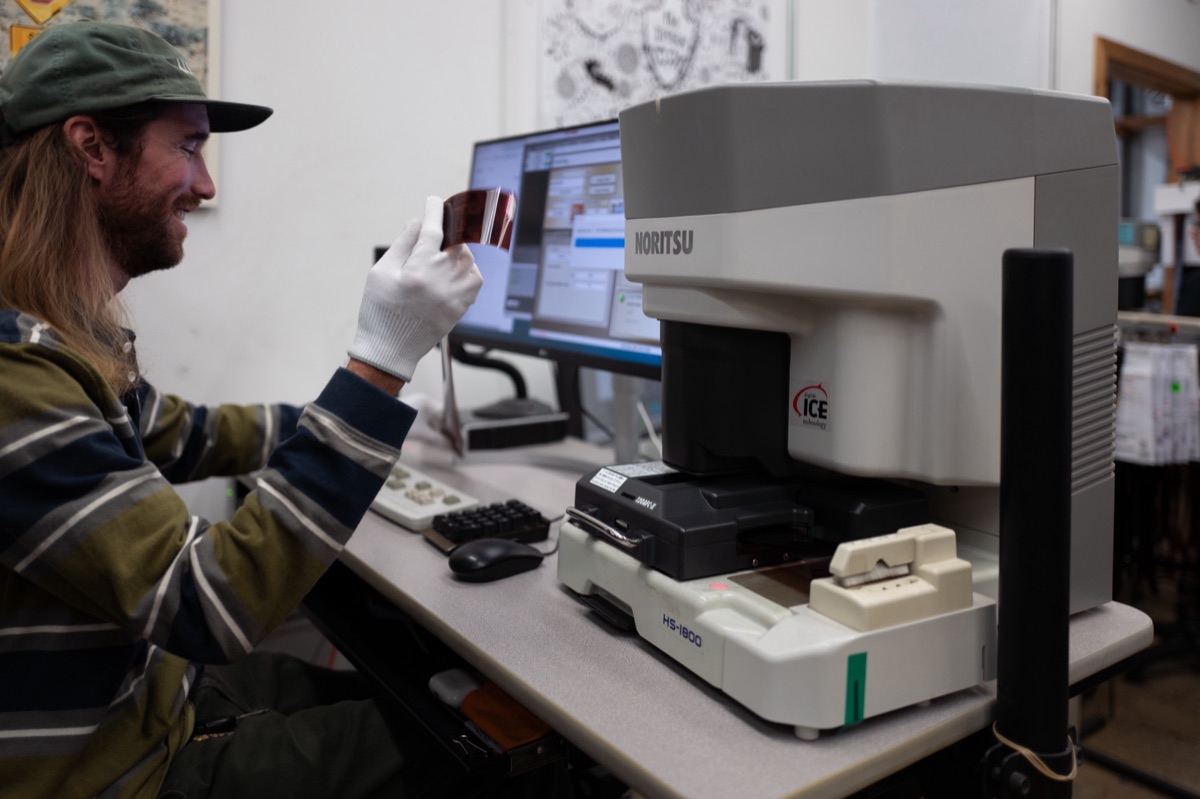
Almost nowhere, which is why people end up here. No drugstore or big-box counter has handled 828 film in decades, and most mail-in labs turn it away because the tiny spool and the unperforated film fit none of their equipment. We develop 828 film for $14 a roll in our own lab, in color (C-41), black & white or slide (E-6), original rolls and respooled 35mm alike, on our dip-and-dunk line. Either way your negatives come back to you.
The film is the same width, 35mm, but that is where it ends. 35mm (135) film comes in a metal cassette, has sprocket holes along both edges and gives a 24 x 36mm picture. 828 film has no sprocket holes, is wound on a small spool with paper backing like a miniature 120 roll, loads in daylight, shows its frame numbers through a red window, and uses the space the sprockets would take for a bigger 28 x 40mm picture. A roll holds eight pictures instead of 24 or 36.
No. Kodak made the last 828 in 1985 and nobody has made paper-backed unperforated 35mm since. What you can buy is expired stock on eBay, usually Verichrome Pan, which is a gamble as fresh film. The practical way to shoot a Bantam today is to respool ordinary 35mm film onto an 828 spool with a strip of 828 backing paper, in the dark. The sprocket holes show at the top and bottom of each picture, which many people like. See the next question.
Yes, with a little work. You need an 828 spool, ideally two, and a strip of 828 backing paper, which is why we return both if you ask. In a changing bag or a completely dark room, cut about 16 inches of 35mm film from a cassette, tape it to the backing paper where the original film was taped, and wind the two together onto the spool. Load the camera normally and read the frame numbers through the red window. The sprocket holes intrude into the 28 x 40mm frame along both long edges. Send the exposed roll to us as 120 / 620 film, note “828” in the order notes, and ask for the spool and paper back.
Often, yes. Black & white rolls such as Verichrome Pan and Panatomic-X are the best candidates: expect fog and low contrast, but the pictures are usually still there. Color is harder: Kodacolor-X 828 used the C-22 process, which no longer exists, so it can only be developed as black & white, and Kodachrome 828 we cannot process at all. Order it as 120 / 620 film, $14 a roll, and if you are not sure what you have, send us a photo of the roll first.
Only if you ask, so ask. Spools and backing paper are normally recycled, and 828 spools have not been made for forty years; without one and a strip of paper, a Bantam cannot be reloaded at all. Write “return my 828 spool and paper” in the order notes at checkout and we will tuck a spool and paper in with your negatives. Expect a similar 828 spool, likely not the exact one you mailed; any 828 spool fits any Bantam.
Eight, each 28 x 40mm. That is about 30 percent more picture area than a 35mm frame, which was Kodak’s whole argument for the format in 1935. A strip of 35mm respooled onto an 828 spool gives the same eight frames.
828 is an odd size, so it is handled and scanned individually rather than on the automated 35mm and 120 line. Most 828 orders are produced in 7–10 business days after we receive them. For anything current that might affect that, see our lab status page.
Kodak’s attempt to make 35mm simpler, and the film behind one of the prettiest cameras ever built. Part of our guide to popular film formats.
Kodak introduced 828 film in 1935, a year after its own 135 cassette, as a second answer to the same question: how to sell 35mm film to people who found cassettes and sprockets fiddly. 828 took the 35mm-wide film, left off the perforations, backed it with paper and wound it on a spool small enough to disappear in a shirt pocket. It loaded in daylight like a roll film, needed no rewinding and no sprocket drive, and because nothing had to clear the perforations the picture could grow from 24 x 36mm to 28 x 40mm. The camera built for it was the Kodak Bantam, a folding pocket camera, and the format has been called Bantam film ever since.
The Bantam Special of 1936, an Art Deco folding camera with a fast Ektar lens, styled by Walter Dorwin Teague, is now one of the most collected Kodaks ever made, and the plainer Bantams, the Flash Bantam, the Bantam RF and the plastic Pony 828 kept the format alive through the 1950s. Kodachrome was sold in 828, and the resulting 28 x 40mm transparencies, mounted in standard 2 x 2 inch mounts as Bantam slides, projected in any 35mm projector with a visibly bigger picture. But 135 won. Cameras for the cassette multiplied, cameras for 828 did not, and Kodak made the last 828 film in 1985 for the Bantams still in drawers.
828 film is 35mm wide, the same stock as the film in a 35mm cassette, but with no sprocket holes and a strip of opaque paper backing. The spool is the smallest Kodak made for a roll film, about 1½ inches long, and a roll holds eight frames of 28 x 40mm. Here is how it compares with the formats it is most often confused with:
| Format | Film width | Package | Picture size | Pictures |
|---|---|---|---|---|
| 828 film | 35mm, no sprockets, paper-backed | Tiny spool, daylight loading | 28 x 40mm | 8 |
| 35mm (135) film | 35mm, perforated | Metal cassette with leader | 24 x 36mm | 24 or 36 |
| 126 film | 35mm, paper-backed, one hole per frame | Drop-in plastic cartridge | 28 x 28mm | 12, 20 or 24 |
| 127 film | 46mm, paper-backed | Short spool, daylight loading | 40 x 40mm or 40 x 65mm | 8, 12 or 16 |
Two other paper-backed 35mm roll films existed, Bolta film for the German Boltavit and Photavit cameras and the film Konishiroku made for the Japanese Konilette, and they are handled the same way as 828 if you find one. It is sometimes written as “828mm film” online; there is no such thing, the number is Kodak’s catalog size, like 120 and 620.
Because 828 is just 35mm without holes, a Bantam is one of the easiest dead-format cameras to bring back, provided you have one original 828 spool and a strip of its backing paper. In a changing bag, pull about 16 inches of film from a 35mm cassette, cut it, tape its end to the backing paper in the spot where Kodak taped the original, roll the paper and film tightly onto the 828 spool and tuck the end under. Load it like any roll film and read the numbers through the red window. The sprocket holes run along both long edges of every frame, inside the 28 x 40mm gate, so the pictures come out with a perforated border that has become part of the look.
Mail the exposed roll to us as 120 / 620 film with “828” in the order notes. It develops normally and is scanned frame by frame at the full 28 x 40mm, perforations and all. And always ask for the spool and paper back; they are the one part of the setup you cannot buy. You will get a similar spool back, likely not the exact one.
Nothing has been made in the size since 1985, and unlike 127 or 620 no specialist has taken it up, so 828 survives through respoolers and found rolls. The found rolls arrive here a few at a time: a Verichrome Pan 828 still in a Flash Bantam, a Kodacolor-X 828 from a 1960s vacation that can now only be rescued as black & white. The respoolers are mostly people who fell for a Bantam Special and refused to let it sit on a shelf. Both are welcome. If you are not sure what you have, send us a photo of it; our guide to developing old rolls of film covers what to expect from film this age, and our 35mm film guide covers the cassette that won.
Sources: Camerapedia, Kodak product histories.
Every format has its own page, with the history and the developing details. Or see the whole guide.














 FAQ