116 film and 616 film are Kodak’s big 70mm roll films, made from 1899 to 1984 for a generation of folding cameras whose 6.5 x 11cm negatives could be printed without an enlarger. Yes, they can still be developed, and we do it in our own lab: original 70mm rolls found in old cameras, and 120 film shot in a 116 or 616 camera today. Scans go to your free web gallery and your negatives are mailed back.
Start Your 116 / 616 Order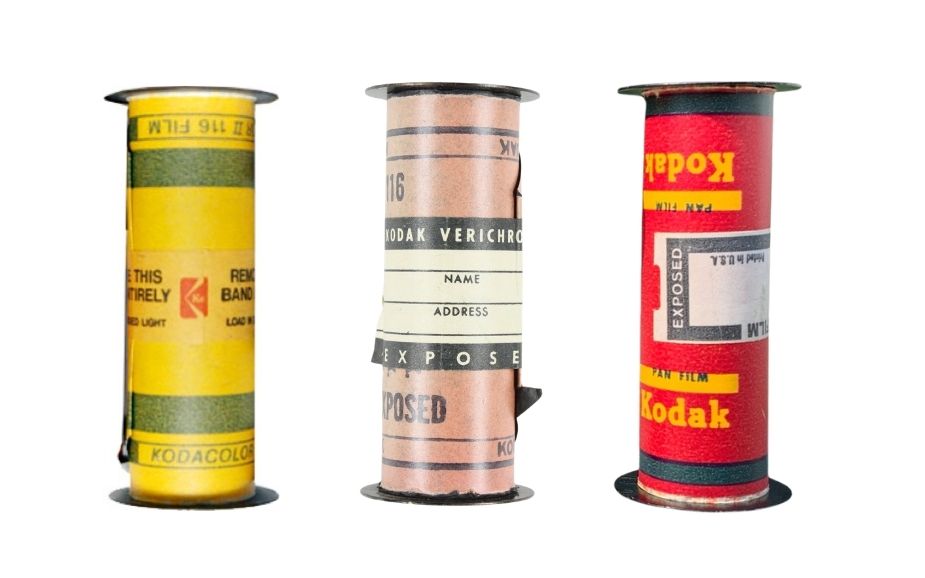 We processC-41 · B&W
Quality developingSince 1976
A paper-wrapped roll that is noticeably longer and fatter than 120, or a folding Kodak that a 120 roll rattles around in? Here’s how to tell 116 film and 616 film from the rest.
No roll film this wide has been made since 1984, so every roll of 116 film or 616 film is either a decades-old find or 120 film repurposed for an old camera. Both are developed here. Here’s what we process, what you get back, and what to check before you mail it.

Original 116 and 616 rolls are the 120 price plus the 220 Format option. 120 film shot in a 116 camera is the 120 price plus the panoramic option. No hidden fees.
| Add-ons per roll | |
|---|---|
| Enhanced scans Our recommended size | + $2 |
| Super scans Largest files, best for enlargements | + $6 |
| Color 4×6 prints | + $10 per set |
| True black & white 4×6 prints On real silver gelatin paper | + $20 per set |
| Push or pull processing | + $3 |
| Do not cut negatives | + $3 |
| Other options | |
| 120 film shot in a 116 or 616 camera $14 base + $10 panoramic option for the 56 x 108mm frames | $24 |
| Develop only, no scans $11 base + $10 220 Format option | $21 |
| Inbound shipping Printable label or free postage-paid mailer | Free |
| Return shipping Unlimited rolls per order | $6.95 |
Pick 120 / 620 as your film type. For an original 116 or 616 roll, select the 220 Format option; for 120 film shot in a 116 camera, select the panoramic option. Choose your scan size and any prints, and check out.
Print your free shipping label, or request a postage-paid mailer and we’ll send one to you. Tape the band on each roll, note anything unusual, and send it.
We email you the moment your scans land in your online gallery. Share, download, or order prints. Your negatives, your spools if you asked for them, and any prints follow in the mail.
Almost nowhere, which is why people end up here. No drugstore or big-box counter has handled 70mm roll film in decades, and most mail-in labs turn it away because it fits none of their equipment. We develop original 116 film and 616 film for $24 a roll, in color or black & white, on our dip-and-dunk line, and we develop 120 film shot in 116 and 616 cameras every week as ordinary 120. Either way your negatives come back to you.
The spool, exactly as with 120 and 620. Both hold the same 70mm-wide film with the same backing paper and give the same 6.5 x 11cm pictures. 116, from 1899, has a thick spool with large flanges. 616, introduced by Kodak in 1932, winds the same film on a slimmer spool with a narrow metal core so the camera could be a little smaller. A 116 roll will not fit a 616 camera. We develop them the same way.
No. Kodak made the last 116 and 616 in 1984, and nobody has made 70mm roll film with backing paper since. What you can buy is expired stock on eBay, usually Verichrome Pan from the 1950s to 70s, which sometimes still holds a latent image but is a gamble as fresh film. The practical way to shoot a 116 or 616 camera today is 120 film, either respooled onto a 116 spool or held in place by a 3D-printed adapter. See the next question.
Yes, and the results are the reason to bother: the camera’s 6.5 x 11cm gate on 61.5mm-wide film gives long 56 x 108mm panoramic negatives, about seven per roll. Two methods. Adapters: 120-to-116 and 120-to-616 adapter sets, usually 3D-printed, hold a 120 roll centered in the longer chamber and let the camera wind onto a 116 or 616 take-up spool. Respooling: in the dark, wind the 120 film onto an original 116 or 616 spool, ideally inside a strip of old 116 backing paper so the frame numbers line up. The 120 numbers will not match the red window otherwise, so most people count turns of the winding key instead. Send the exposed roll to us as 120 film with the panoramic option.
Often, yes. Black & white rolls such as Verichrome, Verichrome Pan and Panatomic are the best candidates: expect heavy fog and low contrast, but faces and places are usually still there. Color rolls are a different story: Kodacolor 116 and 616 used the C-22 process, which no longer exists, so they can only be developed as black & white. Order it as 120 / 620 film with the 220 Format option, $24 a roll, and if you are not sure what you have, send us a photo of the roll first.
Only if you ask, so ask. Empty spools are normally recycled, and 116 and 616 spools have not been manufactured for forty years; without one, a camera cannot take up film at all. Write “return my spools” in the order notes at checkout and we will tuck spools in with your negatives. Expect a similar spool, likely not the exact one you mailed; any 116 spool fits any 116 camera, and the same goes for 616.
Eight 6.5 x 11cm pictures on a standard roll. The earliest 116 rolls held six, which is where the “6” in 616 is often said to come from, and later rolls were lengthened to eight without changing the name. A 120 roll run through the same camera gives about seven panoramic frames.
120 film shot in a 116 camera follows the 120 schedule: most orders are developed, scanned and uploaded within 2–4 days of arriving. Original 70mm rolls are handled and scanned individually, so allow 7–10 business days. For anything current that might affect that, see our lab status page.
The big roll from the age when the negative was the print. Part of our guide to popular film formats.
Kodak introduced 116 film in 1899 for the No. 1A Folding Pocket Kodak, two years before 120, and for the next three decades it was the family snapshot format. The reason was simple: in the days of slow, grainy emulsions, a bigger negative meant a sharper picture, and a 6.5 x 11cm negative was big enough to lay straight onto a sheet of printing paper. Most 116 pictures were never enlarged at all. They were contact printed, which is why so many of the prints in old albums are exactly the size of a 116 negative, 2½ by 4¼ inches, often with deckled edges.
616 arrived in 1932, the same year as 620 and for the same reason. Kodak wound the identical film onto a slimmer spool so its new Six-16 cameras could be a little smaller, and since only Kodak held the design, it sold the film those cameras needed. The Kodak Six-16, Junior Six-16, Senior Six-16, Vigilant Six-16 and Monitor Six-16 followed, along with box Brownies in the same size. Agfa and Ansco sold the 116 size as PD16 for their Clipper and Plenax cameras. By then 35mm and 120 were taking over, and both big formats faded through the 1950s. Kodak kept making 116 and 616 for the cameras still in drawers until 1984.
The film is 70mm wide, about 2¾ inches, the widest roll film ever sold to the public, and the spools are about 3 inches long between the flanges. The standard picture is 6.5 x 11cm, a long 1:1.7 rectangle that gives these cameras their distinctive wide look. Here is how the two sizes compare with the rolls they are mistaken for:
| Format | Film width | Spool | Picture size | Pictures |
|---|---|---|---|---|
| 116 film | 70mm, paper-backed | Thick, large flanges, about 3 in long | 6.5 x 11cm | 8 (6 early) |
| 616 film | 70mm, paper-backed | Slim, narrow metal core, about 3 in long | 6.5 x 11cm | 8 |
| 120 film | 61.5mm, paper-backed | Plastic or metal, about 2½ in long | 6×4.5 to 6x9cm | 8 to 16 |
| 620 film | 61.5mm, paper-backed | Slim metal, about 2½ in long | 6×4.5 to 6x9cm | 8 to 16 |
| 120 in a 116 camera | 61.5mm | Adapter or respooled | 5.6 x 10.8cm panoramic | About 7 |
Because the cameras are plentiful, cheap and often beautifully made, people keep finding ways to feed them. 120 film is 8.5mm narrower than 116, so it does not fill the gate, but the camera does not know that: it exposes a 56mm-tall strip across the full 108mm width, which is a panoramic frame about the shape of a 6×12. A 120 roll yields around seven of them.
The easy route is an adapter set, sold online and often 3D-printed, that centers a 120 roll in the 116 chamber and extends its spool to fit the camera’s pins; the film winds onto an original 116 or 616 spool on the take-up side, so you need at least one. The traditional route is respooling in a changing bag: wind the 120 film, backing paper and all, onto a 116 or 616 spool. Either way the frame numbers printed on 120 paper do not line up with a 116 red window, so shooters count winding-key turns or tape a strip of old 116 backing paper in. Mail the exposed roll to us as 120 film with the panoramic option, and ask for your spools back.
No 116 film or 616 film has been made since 1984, and unlike 127 or 620 no specialist has taken it up, because 70mm backing-paper roll film has no modern source. What survives is the cameras, which are everywhere, and the found rolls, which arrive here a few at a time: a Verichrome Pan 616 still in a Kodak Monitor, a Kodacolor 116 from a 1960s road trip. We develop them by hand, and the pictures that come off them, faint, square-cornered and seventy years old, are some of the most satisfying we see. If you have one, order it as 120 / 620 film with the 220 Format option and mail it in; if you are not sure what you have, send us a photo of the roll first. Our guide to developing old rolls of film covers what to expect from film this age.
Sources: Camerapedia, Kodak product histories.
Every format has its own page, with the history and the developing details. Or see the whole guide.







 FAQ