127 film is Kodak’s Vest Pocket roll film: a 46mm-wide paper-backed roll, smaller than 120, that gave a century of folding cameras, Brownies and baby twin-lens reflexes their square 4x4cm pictures. Yes, it can still be developed, and we do it in our own lab, in color (C-41), black & white and E-6 transparency film. Scans go to your free web gallery and your negatives are mailed back.
Start Your 127 Order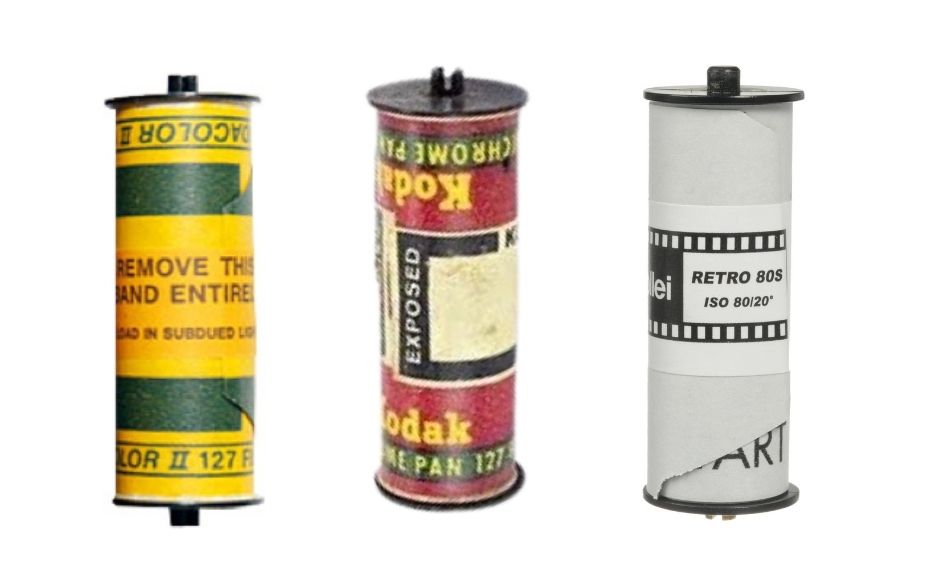 We processC-41 · B&W · E-6
Quality developingSince 1976
A little paper-wrapped roll that looks like a short, skinny 120? Here’s how to tell 127 film from its bigger and smaller relatives.
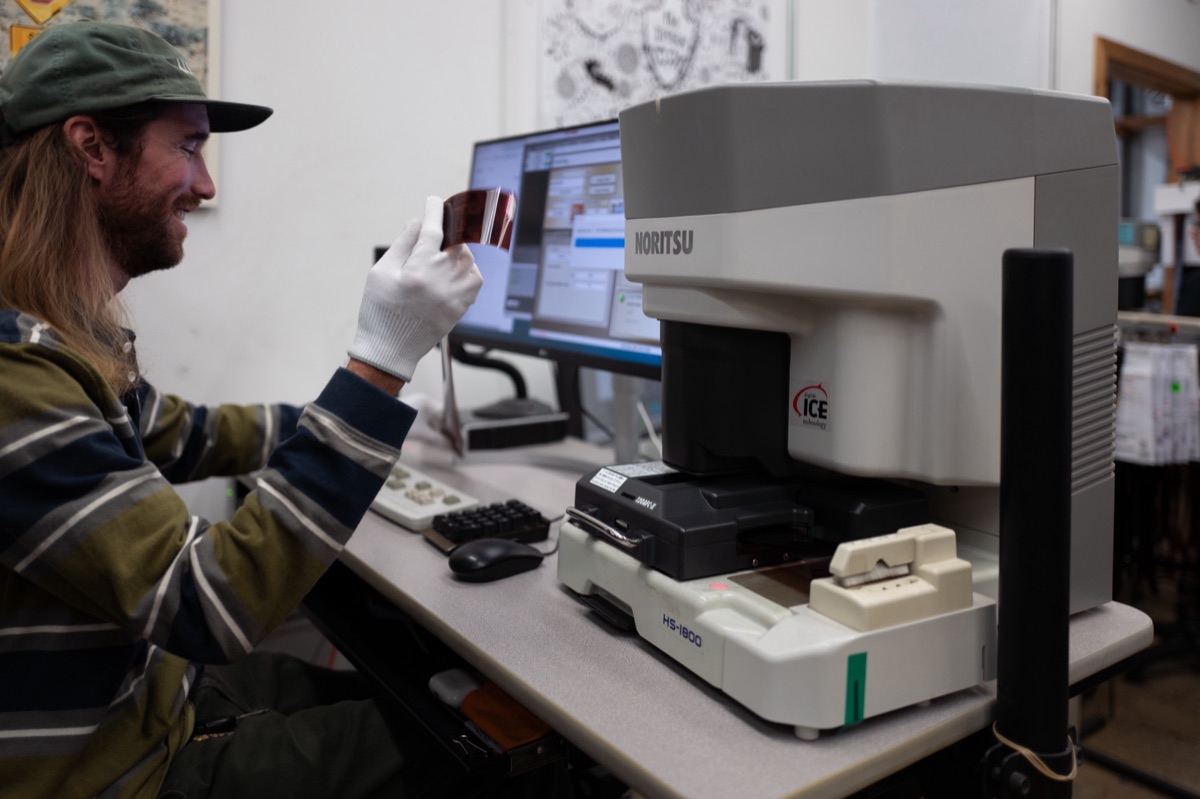
127 runs through our Refrema dip-and-dunk developers, where the film hangs on racks instead of passing through rollers, and is scanned by hand on our Fuji Frontier. Here’s what we process, what you get back, and what to check before you mail it.

The 120 price plus a 127 add-on for the odd size, then the options you choose at checkout. No hidden fees.
| Add-ons per roll | |
|---|---|
| Enhanced scans Our recommended size | + $2 |
| Super scans Largest files, best for enlargements | + $6 |
| Color 4×6 prints | + $10 per set |
| Color 5×7 prints | + $18 per set |
| True black & white 4×6 prints On real silver gelatin paper | + $20 per set |
| Transparency film (E-6) The slide film option at checkout | + $6 |
| Push or pull processing | + $3 |
| Cross processing | + $3 |
| Do not cut negatives | + $3 |
| Other options | |
| Develop only, no scans $11 base + $6 for 127 film | $17 |
| Inbound shipping Printable label or free postage-paid mailer | Free |
| Return shipping Unlimited rolls per order | $6.95 |
Pick 120 / 620 as your film type, add the 127 film type option, choose your scan size and any prints, and check out. One order can hold as many rolls as you have.
Print your free shipping label, or request a postage-paid mailer and we’ll send one to you. Tape the band on each roll, drop them in and send it.
We email you the moment your scans land in your online gallery. Share, download, or order prints. Your negatives and any prints follow in the mail.
A search for 127 film developing near you usually ends at a photo counter that mails the film out anyway. Drugstore and big-box counters never had equipment for 127, and the ones that still take roll film at all send it to a third-party lab, with turnaround measured in weeks and, in many cases, no negatives returned. We develop 127 film in our own lab in California, on the same dip-and-dunk line as 120, and your negatives always come back to you.
Yes, in small batches. Kodak made its last 127 in 1995 and Efke, the last big maker, stopped in 2012, but a few specialists keep cutting it: ReraPan 100 black & white from Japan, Rollei Retro 80S in 127, and color and black & white rolls hand-cut and spooled by the Film Photography Project store. Expired Kodak 127 turns up on eBay and at estate sales, and some shooters slit 120 film down to 46mm in the dark. We develop all of it.
Size. Both are paper-backed roll films that load the same way and show frame numbers through a red window, but 127 is 46mm wide on a short spool while 120 is 61.5mm wide on a longer one. A 127 picture is 4x4cm (or 4×6.5cm, or 3x4cm) against 6x6cm and up for 120. The two are not interchangeable: a 127 roll is loose in a 120 camera and a 120 roll will not fit a 127 camera. We develop both; 127 just needs its own add-on at checkout.
Yes. Most of the 127 film we develop is a found roll from the 1950s or 60s, often still inside a Brownie, and most of them hold pictures. Black & white Verichrome Pan ages gracefully; expect some fog and lower contrast. Color rolls shift and fade more. Kodacolor-X and other C-22 color films from before 1973 used a chemistry no longer available; we can process those rolls as black & white instead. Kodachrome, and Ektachrome-X and other E-4 transparency films from before 1977, we cannot process at all.
It depends on the camera: 12 square 4x4cm pictures in a Brownie Starflash, Baby Rolleiflex or Yashica 44; 8 pictures at 4×6.5cm in a Vest Pocket Kodak or Brownie 127; 16 pictures at 3x4cm in a 1930s camera like the Zeiss Ikon Kolibri. The backing paper carries three rows of numbers, one for each.
Yes, if it is E-6 film. In roll film sizes like 127, E-6 film is called transparency film rather than slide film; it only becomes a slide once a frame is mounted. We run E-6 in house; choose the slide film option at checkout, and your transparencies are scanned and returned in sleeves, unmounted. If you want 4×4 Superslides for a projector, you will need to mount them yourself; 2×2 Superslide mounts are still sold. Kodachrome 127 and pre-1977 Ektachrome-X (E-4) are the exceptions: those processes are gone, and we cannot process them at all.
Your negatives always come back. Empty spools are normally recycled, so if you need your 127 spools for the next roll, say so in the order notes at checkout and we will return them with your negatives. Spools are the scarce part of shooting 127, so it is worth asking.
127 is an odd size, so it is handled and scanned individually rather than on the automated 35mm and 120 line. Most 127 orders are produced in 7–10 business days after we receive them. For anything current that might affect that, see our lab status page.
Because none of the standard equipment fits it. 127 is loaded onto its own racks for developing and scanned frame by frame by hand, which is what the $6 add-on covers. The base price is the same as 120.
The Vest Pocket roll film that outlived every camera built for it. Part of our guide to popular film formats.
Kodak introduced 127 film in 1912 with the Vest Pocket Kodak, a folding camera small enough to live in a waistcoat pocket, which is where the film got its nickname. The camera went to war in the pockets of soldiers on both sides of the First World War, sold by the millions, and gave the format its first picture size: eight exposures of 4×6.5cm on a 46mm-wide roll. For twenty years nearly every camera maker built a folding “vest pocket” model around it, and in Japan the film was simply called Vest film into the 1950s.
The format was reinvented twice. In the 1930s, with the Depression on, makers squeezed sixteen 3x4cm frames out of the same roll, starting with the Zeiss Ikon Kolibri. Then in the 1950s came the square: twelve 4x4cm frames per roll, in cameras from the humble Kodak Brownie Starflash and Starmite to the Baby Rolleiflex, the Yashica 44 and Sawyer’s Mark IV, little twin-lens reflexes that were serious cameras in miniature. Kodak’s Brownie 127, a bakelite box sold in Britain from 1952 to 1967, moved several million units on its own. The 4×4 slide, mounted in a standard 2×2 frame and sold as the Superslide, could be shown in any 35mm projector with a picture nearly twice the size.
127 film is 46mm wide, sitting between 35mm and the 61.5mm of 120, and comes on a spool about 2 inches long. It is paper-backed from end to end like 120, so it loads in daylight and the camera reads the frame numbers through a red window. The backing paper is printed with three rows of numbers, one for each picture size the format has carried:
| Frame size | Negative (approx.) | Pictures per roll | Typical cameras |
|---|---|---|---|
| 4×4 (square) | 40 x 40mm | 12 | Brownie Starflash, Starmite and Starflex, Baby Rolleiflex, Yashica 44, Sawyer’s Mark IV, Bencini Comet |
| 4×6.5 | 40 x 65mm | 8 | Vest Pocket Kodak, Kodak Brownie 127, Dolly Vest Pocket, folding cameras of the 1910s and 20s |
| 3×4 (half frame) | 30 x 40mm | 16 | Zeiss Ikon Kolibri, Foth Derby, 1930s folders |
For comparison, a 35mm frame is 24 x 36mm and a 6×6 frame on 120 is 56 x 56mm. A 4×4 127 negative has nearly twice the area of a 35mm frame, which is why those Baby Rolleiflex pictures look so smooth and why the format earned the label “medium format in miniature”. It is sometimes written as “127mm film” online; there is no such thing, the number is Kodak’s catalog size, like 120 and 620.
Kodak stopped making 127 in 1995, and the format spent the next two decades on life support from a single Croatian factory: Efke, whose R100 127 was the last film made on the original machines until Fotokemika closed in 2012. Then the enthusiasts took over. ReraPan 100, cut in Japan, keeps black & white 127 on the shelves; Rollei Retro 80S is offered in 127; and the Film Photography Project hand-cuts and spools color and black & white 127 from larger stock, selling the spools and backing paper as well. A few shooters slit 120 down to 46mm themselves with a homemade jig.
At the lab, most of the 127 film we develop is one of two things: a found roll of Verichrome Pan from a parent’s Brownie, or fresh film from someone who picked up a Baby Rolleiflex or a Yashica 44 and discovered what a 4×4 negative can do. Both come out. If you are not sure which process your roll needs, mail it in and we will read the band. Our guide to developing old rolls of film covers what to expect from film this age, and our 120 film guide covers the bigger roll it is so often mistaken for.
Sources: Camerapedia, Kodak product histories, Film Photography Project.
Every format has its own page, with the history and the developing details. Or see the whole guide.









 FAQ