220 film is 120 film at twice the length: the same 61.5mm medium format roll with no backing paper, so twice the pictures fit on one spool. Yes, it can still be developed, and we do it in our own lab, in color (C-41), black & white and E-6 transparency film, whether the roll came out of a freezer or off the shelf last week. Scans go to your free web gallery and your negatives are mailed back.
Start Your 220 Order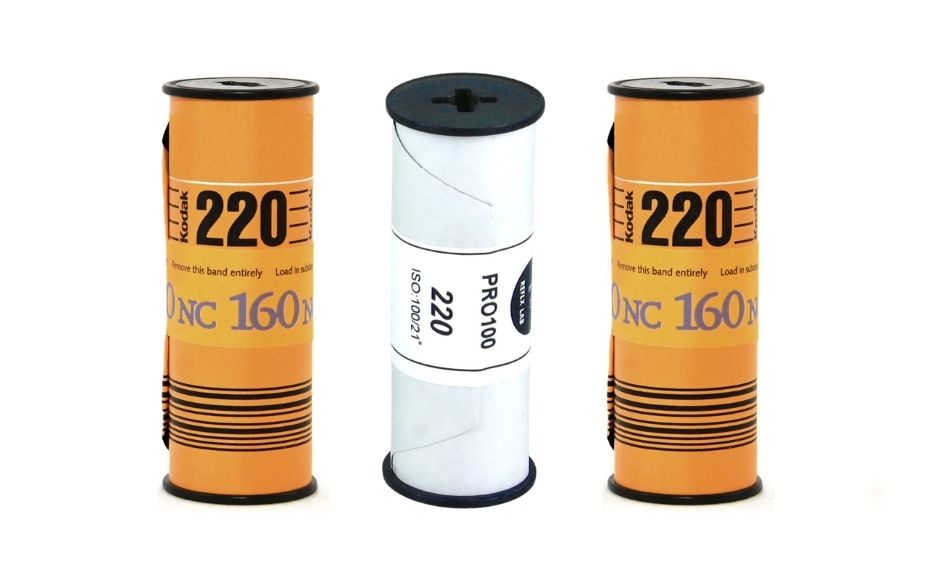 We processC-41 · B&W · E-6
Quality developingSince 1976
A medium format roll that looks exactly like 120 but says 220 on the band? Here’s how to tell 220 film from 120, and why it matters before you load it.

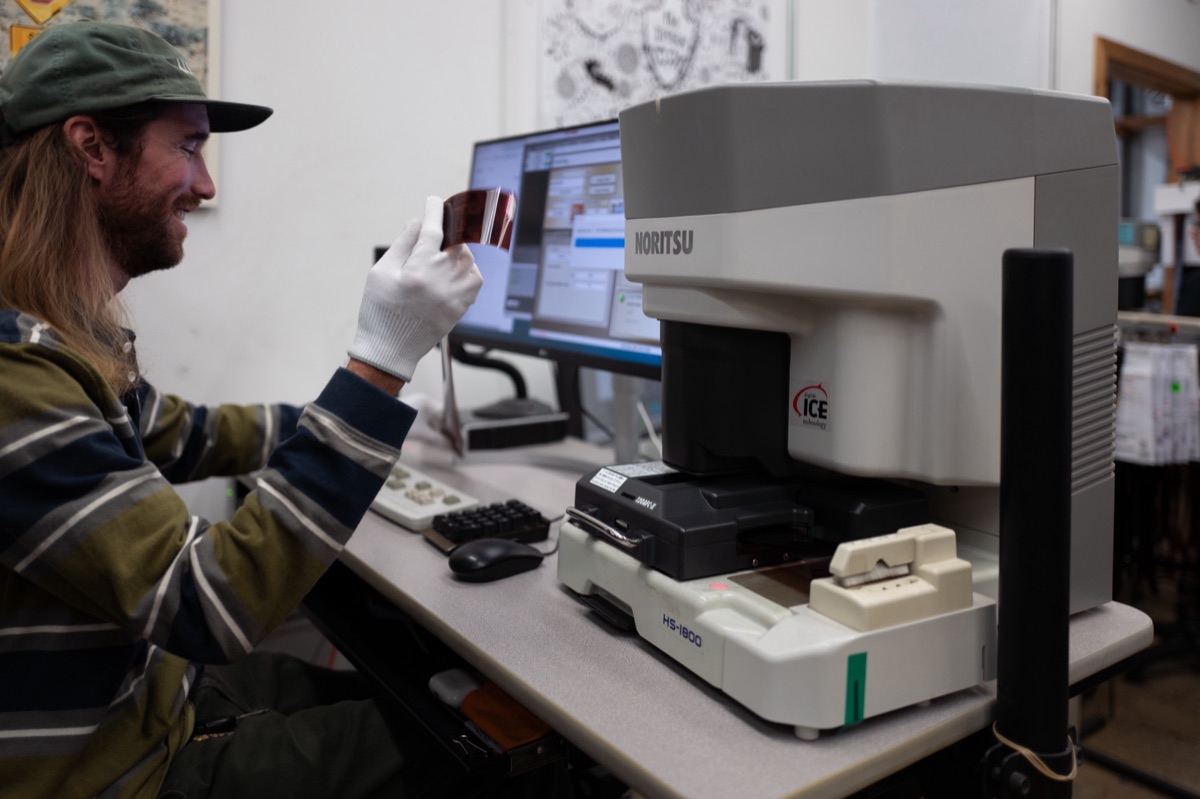
220 is the same film as 120, only longer, so it runs through the same line: our Refrema dip-and-dunk developers, where the film hangs on racks instead of passing through rollers. Here’s what we process, what you get back, and what to check before you mail it.

The 120 price plus a 220 add-on for the double length, then the options you choose at checkout. No hidden fees.
| Add-ons per roll | |
|---|---|
| Enhanced scans Our recommended size | + $2 |
| Super scans Largest files, best for enlargements | + $6 |
| Color 4×6 prints | + $10 per set |
| Color 5×7 prints | + $18 per set |
| True black & white 4×6 prints On real silver gelatin paper | + $20 per set |
| Transparency film (E-6) The slide film option at checkout | + $6 |
| Push or pull processing | + $3 |
| Cross processing | + $3 |
| Do not cut negatives | + $3 |
| Other options | |
| Develop only, no scans $11 base + $10 for 220 format | $21 |
| Inbound shipping Printable label or free postage-paid mailer | Free |
| Return shipping Unlimited rolls per order | $6.95 |
Pick 120 / 620 as your film type, add the 220 format option, choose your scan size and any prints, and check out. One order can hold as many rolls as you have.
Print your free shipping label, or request a postage-paid mailer and we’ll send one to you. Tape the band on each roll, drop them in and send it.
We email you the moment your scans land in your online gallery. Share, download, or order prints. Your negatives and any prints follow in the mail.
A search for 220 film developing near you usually ends at a photo counter that mails the film out anyway. Most drugstore and big-box counters stopped handling medium format roll film years ago, and the ones that still take it send the film to a third-party lab, with turnaround measured in weeks and, in many cases, no negatives returned. We develop 220 film in our own lab in California, on the same line as 120, and your negatives always come back to you.
Length and backing paper. Both are 61.5mm wide on the same spool and give the same size pictures. A 120 roll has opaque paper running behind the whole film and holds about 82cm of film. A 220 roll drops the paper behind the picture area, keeping only a paper leader and trailer, which makes room for about 144cm of film: twice the exposures. Because there is no paper, 220 needs a camera or back with a pressure plate set for the thinner roll and a counter that goes past 12, and it cannot be used in a camera that reads frame numbers through a red window.
Barely. Kodak dropped Portra in 220 around 2014 and Fujifilm made its last 220, Pro 160NS, in 2017, which ended the big-brand era. Since then a couple of small runs have appeared: Shanghai GP3 black & white and CineStill 400D color are sold in 220 at the time of writing, and they sell out fast. Most 220 shot today is expired stock from eBay, estate sales and freezers. We develop all of it.
Only if the camera has a 220 setting or a 220 back. In a 120-only camera the counter stops after the first 12 (or 15, or 8) frames and will not advance further, so half the roll goes unexposed, and the pressure plate sits a fraction too far back, which can soften focus. In a red-window camera the window fogs the film, since there is no paper to block the light. If you have already shot 220 in a 120 camera, send it anyway: we develop whatever is on the roll.
Twice what 120 gives in the same camera: 32 on a 6×4.5, 24 on a 6×6, 20 on a 6×7 and 16 on a 6×9. Panoramic 6×12 and 6×17 cameras get 12 and 8. Every frame is scanned, and the 220 add-on at checkout is what covers the extra frames.
Yes, and most 220 we see is expired, because so little has been made since 2017. Frozen or refrigerated rolls often come out looking fresh. Rolls that sat in a warm drawer show color shifts, fog or grain, more so for fast film. Our guide to shooting and developing expired film covers how to rate it and what to expect. The only rolls we cannot develop in color are pre-1973 C-22 films; those we process as black & white.
Because it is two rolls of 120 worth of film on one spool: twice the length through the developer and twice the frames to scan, check and sleeve. The 220 add-on is $10 on top of the $14 base, which still works out cheaper per picture than two rolls of 120.
The same as 120. We develop, scan and upload most 120 and 220 orders within 2–4 days of receiving them, and your negatives follow in the mail. For anything current that might affect that, see our lab status page.
Yes. Ektachrome, Provia, Velvia and Astia were all sold in 220 for wedding and studio work, and we run E-6 in house. In 220, as in 120, E-6 film is called transparency film rather than slide film, since nothing is mounted as a slide. Choose the slide film option at checkout along with the 220 add-on, and your transparencies are scanned and returned in sleeves.
The long roll that kept wedding and studio photographers shooting between reloads. Part of our guide to popular film formats.
Kodak introduced 220 film in 1965 for one kind of photographer: the professional who could not afford to stop and reload. A roll of 120 gives a wedding photographer twelve square frames before the camera has to come down, the back has to come off and a new roll has to be threaded. 220 doubled that to twenty-four, and in a 6×7 studio camera it stretched ten frames to twenty. For thirty years that made it the working film of wedding, portrait, school and catalog photographers, which is why so much of it turns up today in the freezers of retired studios.
The trick was simple. 120 film is wound with a strip of opaque backing paper running the whole length of the roll, so the roll can be loaded in daylight and the frame numbers can be read through a red window. 220 keeps a paper leader and trailer for daylight loading but drops the paper behind the picture area. The film alone is thinner than film plus paper, so twice as much fits on the same spool. The camera side had to change to match: a pressure plate positioned for the thinner roll, a frame counter that runs to 24 or 32, and no red window. Camera makers answered with 220 backs for the Hasselblad, Mamiya and Bronica systems, 120/220 switches on the Pentax 67, Mamiya 7 and Fuji rangefinders, and the Yashica Mat-124, whose name is the number of frames it counts on either roll.
The two rolls are identical in width, spool and picture size, so the comparison comes down to four things. Length: about 82cm of film on a 120 roll, about 144cm on a 220 roll. Backing paper: full length on 120, leader and trailer only on 220. Camera: 120 loads in anything medium format; 220 needs a 220 setting, insert or back, and will not work in a red-window camera. Count: every frame size gets twice the pictures on 220.
| Frame size | Negative (approx.) | Pictures on 120 | Pictures on 220 | Typical cameras |
|---|---|---|---|---|
| 6×4.5 | 56 x 42mm | 16 | 32 | Mamiya 645, Pentax 645, Bronica ETR |
| 6×6 | 56 x 56mm | 12 | 24 | Hasselblad with A24 back, Rolleiflex, Yashica Mat-124 |
| 6×7 | 56 x 69mm | 10 | 20 | Mamiya RB67 and RZ67, Pentax 67, Mamiya 7 |
| 6×9 | 56 x 84mm | 8 | 16 | Fuji GW690, Mamiya Press |
| 6×12 / 6×17 | 56 x 112mm / 56 x 168mm | 6 / 4 | 12 / 8 | Panoramic cameras (scanned with the panoramic option) |
The pressure plate is the detail people miss. On a camera with a 120/220 switch, the plate moves a fraction of a millimeter to hold the thinner 220 roll flat at the film plane. Shoot 220 on the 120 setting and the film sits slightly back, which can take the edge off sharpness at wide apertures. It is also sometimes written as “220mm film” online; there is no such thing, the number is Kodak’s catalog size, like 120 and 620. Our medium format guide covers the cameras in more depth.
Digital took the wedding and school markets first, and 220 went with them. Kodak trimmed its 220 line through the 2000s, dropped Tri-X Pan Professional in 2010 and Portra in 220 around 2014, and Fujifilm’s Pro 160NS in 2017 was the last 220 from a major maker. For a few years the format was effectively gone. It has crept back on a small scale since: Shanghai GP3 returned in 220 in 2021 and CineStill began offering its 400D in 220, so a 220 back is no longer a paperweight. The bulk of what we develop, though, is older stock, often a brick of Portra or Fuji 160 that spent a decade in a studio freezer and shoots beautifully.
If you are choosing between the two rolls for a camera that takes both, 120 is cheaper, available everywhere and in every emulsion. 220 earns its place when reloading is the problem: a long ceremony, a day of portraits, a camera back that is awkward to change on a tripod. Either way, the roll comes to us the same way and is developed on the same line. See our 120 film guide for the frame sizes, the cameras and what is still in production.
Sources: Camerapedia, Kodak and Fujifilm product histories, ISO 732.
Every format has its own page, with the history and the developing details. Or see the whole guide.





 FAQ