













 FAQ
FAQ


Whether you’re new to film photography or have been shooting film for years, there are a surprisingly large number of terms unique to the analog world. From film formats and camera types to developing techniques and exposure settings, film photography has its own language that can feel a little overwhelming at first.
In this Film Photography Glossary, we’ve put together simple, straightforward explanations for many of the most common film photography terms. We’ll also continue expanding this guide over time with links to related blogs, tutorials, and resources to help you learn more.
Film Formats & Film Types
35mm
The most common and widely used film format. It comes in metal canisters and typically gives you 24 or 36 exposures per roll.
120 Film
A medium format film that produces much larger negatives than 35mm film, resulting in higher image quality, smoother grain, and more detail. Depending on the camera, 120 film can be shot in a variety of formats including 6×4.5, 6×6, 6×7, 6×8, 6×9, and panoramic formats like 6×17, with each format offering a different aspect ratio and number of exposures per roll.
Medium Format
A category of film cameras and film sizes larger than 35mm but smaller than large format. Medium format sizes include 6×4.5, 6×6, 6×7, 6×8, 6×9, and panoramic formats like 6×17, all of which offer significantly larger negatives, improved image quality, and unique aspect ratios compared to 35mm film.
220 Film
A less common version of 120 film that is twice as long and provides roughly double the exposures. Unlike 120 film, it does not include backing paper throughout the entire roll.
127 Film
A smaller roll film format once popular in vintage cameras. It sits between 35mm and 120 in size and has seen occasional specialty film revivals.
620 Film
An older film format that is essentially the same size as 120 film but wound on a different size spool. Many vintage cameras used 620 film.
110 Film
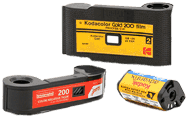
A compact cartridge-based film format introduced for small point-and-shoot cameras. Known for its tiny size, portability, and nostalgic aesthetic.
126 Film
A cartridge-based film format popular in the 1960s and 1970s, often associated with Kodak Instamatic cameras.
Advantix / APS Film
Advanced Photo System (APS) film introduced in the 1990s. It featured drop-in loading and selectable aspect ratios but was eventually discontinued.
Sheet Film
Large individual sheets of film used in large format cameras. Common sizes include 4×5 and 8×10.
Color Negative Film
The most common type of color film, developed using the C-41 process. The developed negatives appear with inverted colors until scanned or printed.
Slide Film (E-6)
A type of film that produces positive transparencies rather than negatives. Known for vibrant colors and high contrast but less exposure latitude.
Infrared Film
A specialty film designed to capture infrared light, often producing surreal images with glowing foliage and dark skies.
Redscale
A technique where film is loaded backward so light passes through the back of the film base first. This creates heavy red, orange, and yellow color shifts.
Film & Camera Components
Film Canister
The container that holds a roll of 35mm film before and after shooting.
Cartridge
A self-contained film loading system used in formats like 110, 126, and APS film.
Film Leader
The small section of film extending from a 35mm canister used to load the film into the camera.
Sprocket Holes
The perforated holes running along the edges of 35mm film that help transport the film through the camera.
Negatives
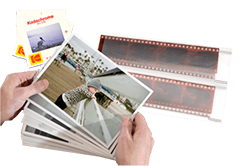
The developed film images where tones and colors are reversed before scanning or printing.
Hot Shoe
The mount located on top of many cameras used for attaching flashes and accessories.
Leaf Shutter
A shutter system typically located inside the lens rather than the camera body. Leaf shutters are often quieter and can sync with flash at higher shutter speeds.
Film Leader Retriever
A tool used to pull the film leader out of a 35mm cartridge.
Camera Types & Formats
Single Lens Reflex (SLR)
A camera that uses a mirror system allowing you to look directly through the taking lens when composing an image.
Twin Lens Reflex (TLR)
A camera with two lenses stacked vertically. One lens is used for viewing and focusing while the other captures the image.
Half-Frame
A format that splits a standard 35mm frame into two smaller exposures, effectively doubling the number of photos per roll.
Panoramic Format
A wide aspect ratio format designed to capture broader scenes. Some panoramic cameras expose extra-wide frames, while others crop standard 35mm film.
Exposure & Camera Settings
Aperture
The opening inside the lens that controls how much light enters the camera. Aperture also affects depth of field.
Shutter Speed
The amount of time the shutter stays open to expose the film to light.
ISO
The film’s sensitivity to light. Lower ISO films generally have finer grain, while higher ISO films work better in low light.
ASA
An older film speed rating system that eventually became standardized as ISO.
Exposure Triangle
The relationship between aperture, shutter speed, and ISO that determines exposure.
Depth of Field
The area of a photo that appears acceptably sharp. Wider apertures create shallower depth of field.
Bokeh
The appearance and quality of out-of-focus areas in a photograph, often associated with smooth or pleasing background blur.
Sunny 16
A classic exposure guideline stating that on a sunny day, you can shoot at f/16 with a shutter speed close to your film ISO.
Middle Gray
A reference tone representing average brightness in a scene, commonly used by light meters for exposure calculations.
Light Meter
A device or built-in camera system that measures light to help determine proper exposure settings.
Underexposure
When too little light reaches the film, often resulting in dark images with loss of shadow detail.
Overexposure
When too much light reaches the film, often producing brighter images with softer contrast.
Exposure Latitude
How forgiving a film is when overexposed or underexposed while still producing usable results.
Developing & Processing Terms
Push Processing
Developing film longer to compensate for underexposure, often increasing contrast and grain.
Pull Processing
Developing film for less time to compensate for overexposure, often reducing contrast and grain.
Cross Processing
Developing film in chemicals intended for a different film type, often creating dramatic color shifts and contrast.
ECN-2
A motion picture film developing process originally designed for cinema film stocks like Kodak Vision3.
Dip and Dunk Processing
A professional film developing method where film is suspended on racks and dipped through chemistry tanks. Known for consistent and even processing results.
Common Film Issues & Characteristics
Blank Roll
A roll of film that produces no visible images after development. This can happen due to loading issues, shutter problems, or severe underexposure.
Light Leak
Unwanted light entering the camera or film holder, often creating streaks, flares, or washed-out areas on film.
Grain
The visible texture of film created by light-sensitive silver halide crystals or dye clouds. Higher ISO films generally show more grain.
Halation
A glowing halo effect around bright light sources caused by light scattering within the film emulsion or backing.
Double Exposure
Exposing the same frame of film multiple times to layer images together creatively.
Printing & Darkroom Terms
True Photographic Paper
Traditional light-sensitive photographic paper exposed using light rather than inkjet printing. Often used for high-quality color darkroom prints.
Silver Gelatin Print
A traditional black-and-white photographic print made using silver-based light-sensitive paper in a darkroom process.